

As a family-run recruitment agency that’s worked with local employers and jobseekers for years, we’ve seen our fair share of policy changes shake up the employment landscape. Some come and go without much impact - others genuinely reshape how people hire, work, and build careers.
The Government's decision to shift from “day one” unfair dismissal rights to a proposed six-month qualifying period has already sparked strong opinions. But from where we sit - working closely with small businesses and candidates every day - there are some practical considerations worth highlighting.
Here’s what this change may mean in practice.
A More Balanced Approach for Small Businesses
Many small employers have been nervous about the idea of day-one unfair dismissal rights. For a family-run shop, a small café, or a growing start-up, every hire is a big investment - not just financially, but emotionally too. When you’ve only got a handful of staff, getting the hiring decision wrong can put real pressure on the whole team.
By setting a six-month qualifying period, the government has created a workable compromise. Employers still need to treat people fairly - and most genuinely do - but they now have a realistic timeframe to assess whether someone is the right fit without immediately worrying about tribunal risks.
By setting a six-month qualifying period, the Government has introduced a compromise that aligns more closely with how most businesses already manage probation. Employers will still need to treat people fairly (and most genuinely do) but they now have a more practical timeframe to make sure the role and individual are the right fit.
This will, in our view, make some business owners more confident about hiring again, especially after years of economic uncertainty.
A Win for Jobseekers Too — Especially Compared to the Old Two-Year Rule
While six months isn’t as protective as day one, it’s still a significant improvement on the previous two-year requirement.
Many people - especially those in hospitality, retail, entry-level roles, or those returning to work after a break - never reached the two-year mark. That meant they had very limited protection if a job changed suddenly or an employer acted unfairly.
Under the new rules, jobseekers may:
For anyone re-entering the job market or moving from temporary to permanent work, this shorter qualifying period could make a meaningful difference.
Potential for More Opportunities and More Hiring
Something we don’t talk about enough is how fear affects hiring. When employers feel their risk is high, they may:
A six-month buffer gives businesses a bit more room to breathe — and this may encourage them to:
And when employers feel more confident, jobseekers often benefit
Reflecting How Most Jobs Work in Reality
Most businesses already use probation periods of three to six months. Bringing the law closer to real workplace practice creates greater clarity.
For jobseekers, this means:
It also ensures that your rights kick in once you’ve proven yourself through a fair and familiar process.
Where We Still Need to Keep an Eye
It’s not all perfect, of course:
As always, how this plays out in the real world will take time. But from what we’re hearing day-to-day, many small businesses feel more confident — and many jobseekers say the six-month threshold feels far more achievable.
Our Take
We’re in the business of connecting people — not pushing them through systems. And from that perspective, the new six-month qualifying period strikes a sensible balance.
We’re in the business of connecting people - not pushing them through systems. And from that perspective, the proposed six-month qualifying period aims to strike a balance that supports both sides of the market.
• Jobseekers gain earlier protection.
• Employers gain confidence to hire.
• The labour market remains flexible but fair.
For us, that’s a step in the right direction.
If you’re a jobseeker unsure how this might affect you, or an employer thinking about how to adapt, we’re always here for a chat. As a small, independently run agency, we pride ourselves on honest, straightforward support - and we’re always happy to help you navigate changes like this.
Reach out — we’re here to help.
 If you are recruiting at the moment, you may have noticed something quite different about the candidate market.There are more people looking for work...more applications are coming through...so on paper, that should make recruiting easier.But is it?From the conversations we are having with businesses across Uxbridge, Windsor and the surrounding areas, the reality is often quite different.Having more candidates available doesn't necessarily mean finding the right person has become easier. In fact, for some employers, it has simply created a different recruitment challenge.The candidate market is changingThere are some encouraging signs appearing in the UK recruitment market with the latest KPMG and REC UK Report on Jobs showed that permanent staff appointments increased in August for the first time since September 2022. Candidate availability also continued to rise sharply, with redundancies, fewer vacancies and concerns around job security contributing to more people looking for their next opportunity.It is certainly a welcome sign that confidence may be starting to return, but while candidate numbers have increased, employers are still understandably cautious about hiring.And when a business does make the decision to recruit, getting that hire right matters more than ever.More applications don't always mean more suitable candidatesPost a vacancy today and, depending on the role, you could receive a significant number of applications.At first glance, that sounds ideal - the problem is that quantity and quality aren't necessarily the same thing!An employer might receive 100 applications, but how many applicants have genuinely read the job description? How many have the right experience? How many are realistically within the salary range? How many can get to the location? And, importantly, how many genuinely want this job?There is also an increasing amount of technology involved in recruitment.AI and automation can now help candidates prepare CVs, write applications ...
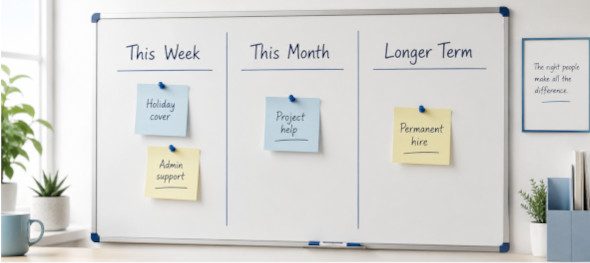 Back in May, we explored why temporary support was driving more hiring conversations.At the time, many businesses weren’t necessarily ready to recruit permanently. However, workloads still needed to be managed, customers still needed to be supported and overstretched teams needed additional help.A few months later, that trend hasn’t disappeared. In fact, flexible hiring is beginning to look less like a temporary response to uncertainty and more like a deliberate part of how businesses plan their teams.The latest KPMG and REC UK Report on Jobs shows temporary billings rising at their fastest rate in more than three years, while permanent recruitment remains cautious.It is an encouraging sign that parts of the market are beginning to stabilise, but businesses are still thinking carefully about how and when they hire.Businesses still need peopleEconomic uncertainty may affect confidence, budgets and long-term decision-making, but it doesn’t remove the need for good people.Projects still begin. Employees take holidays. Workloads increase. Customer expectations continue. Skills gaps emerge, and teams can only absorb extra responsibilities for so long before something starts to give.The question facing many employers is no longer simply:“Should we hire someone?”Increasingly, it is:“What type of support do we need—and what is the most practical way to bring it into the business?”For some organisations, the answer will still be a permanent employee. For others, temporary or project-based support offers the flexibility they need to act now without making a decision that may not suit the business six months from now.Flexibility is becoming a strategic choiceTemporary recruitment has traditionally been associated with short-term cover: sickness, holidays, seasonal demand or an unexpected gap in the team.Those requirements still exist, but the conversations we’re having are becoming broader.Employers are also using flexible support to: Support time-sensitive projects Access ...
 Despite continued uncertainty around budgets, approvals and longer-term hiring decisions, the day-to-day pressures on businesses haven’t slowed down. Work still needs to be delivered, customers still need to be supported and teams still need enough resource around them to keep things moving.As a result, more businesses are quietly turning to temporary support again — not necessarily because they are ready to hire permanently, but because they need reliable support now.Interestingly, many of these conversations are naturally evolving into something more long-term over time.What often starts as:“We just need someone to help for a few weeks…”gradually becomes:“Actually, this role is becoming more important than we first thought.”That’s something we’re seeing more and more.Temporary support has always given businesses flexibility, but in the current climate it’s also giving them breathing space. It allows managers to reduce pressure internally, avoid rushed hiring decisions and keep operations running smoothly while they work out what longer-term structure is actually needed.And importantly, it removes some of the pressure that comes with committing to a full recruitment process immediately.In many cases, businesses simply want support around workload, holidays, projects or gaps in the team. They want someone dependable who can step in quickly, integrate well and help keep momentum going without creating additional disruption.That’s why high-quality temporary staff are proving so valuable right now. They’re no longer viewed purely as short-term cover. Increasingly, they’re becoming part of a more practical and flexible hiring strategy — one that allows businesses to respond to demand as it happens, rather than trying to predict everything in advance.From front-of-house and administration through to customer service, HR and finance support, we’re seeing strong demand for experienced candidates who can make an immediate impact from day one.And in many situations, once a ...
 As a family-run recruitment agency that’s worked with local employers and jobseekers for years, we’ve seen our fair share of policy changes shake up the employment landscape. Some come and go without much impact - others genuinely reshape how people hire, work, and build careers.The Government's decision to shift from “day one” unfair dismissal rights to a proposed six-month qualifying period has already sparked strong opinions. But from where we sit - working closely with small businesses and candidates every day - there are some practical considerations worth highlighting.Here’s what this change may mean in practice. A More Balanced Approach for Small BusinessesMany small employers have been nervous about the idea of day-one unfair dismissal rights. For a family-run shop, a small café, or a growing start-up, every hire is a big investment - not just financially, but emotionally too. When you’ve only got a handful of staff, getting the hiring decision wrong can put real pressure on the whole team.By setting a six-month qualifying period, the government has created a workable compromise. Employers still need to treat people fairly - and most genuinely do - but they now have a realistic timeframe to assess whether someone is the right fit without immediately worrying about tribunal risks.By setting a six-month qualifying period, the Government has introduced a compromise that aligns more closely with how most businesses already manage probation. Employers will still need to treat people fairly (and most genuinely do) but they now have a more practical timeframe to make sure the role and individual are the right fit.This will, in our view, make some business owners more confident about hiring again, especially after years of economic uncertainty.A Win for Jobseekers Too — Especially Compared to the Old Two-Year RuleWhile six months isn’t as protective as day one, it’s still a significant improvement on the previous two-year requirement.Many people - especially those ...